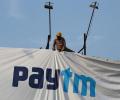
Digital payments and financial services firm Paytm has filed a draft red herring prospectus for its proposed Rs 16,600-crore initial public offering (IPO) with the Securities and Exchange Board of India.

The US Fed interest rate decision, domestic macroeconomic data announcements and ongoing quarterly earnings are some of the major factors that will drive the stock markets in a holiday-shortened week, analysts said. Besides, monthly auto sales numbers and the LIC IPO will also remain in focus, they added. Equity markets will remain closed on Tuesday for Id-Ul-Fitr (Ramzan Id). "The market is likely to kick off this week on a sombre note after a sharp fall in the US market then the focus will shift to the outcome of the US FOMC meeting, which is crucial amid record inflation and growth worries.


The 30-share Sensex dropped 170 points to end at 27,226 and the 50-share Nifty lost 46 points to close at 8,240.

The rupee on Wednesday rose to nearly two-month high of 45.38/39 a dollar by registering a smart 24-paise gain against the US currency on dollar selling amid sustained capital inflows.

Post the correction over the past one year, we are seeing opportunities across sectors.

RBI Governor Shaktikanta Das on Thursday said financial inclusion will continue to be a "policy priority" for the central bank to make the post-pandemic recovery more equitable and sustainable. The Reserve Bank of India will very soon be coming out with the first financial inclusion index, which will assess progress in terms of access, usage and quality, Das said, while speaking at the Economic Times Financial Inclusion Summit. It is the responsibility of all stakeholders to ensure that the financial ecosystem (including the digital medium) is inclusive and capable of effectively addressing risks like mis-selling, cybersecurity, data privacy and promoting trust in the financial system through appropriate financial education and awareness, he added.

Equity markets will look for directions from global trends, ongoing quarterly earnings and investment patterns of foreign institutional investors (FIIs) in a holiday-shortened week ahead and may encounter volatility amid the scheduled monthly derivatives expiry, according to analysts. Equity markets will remain closed on Wednesday on account of 'Republic Day'. "This week is a holiday-shortened one and it's going to be critical due to the list of events and data that are lined up.

FIIs have been strong buyers of shares since last year until a recent streak of selling.

The FPI holding in India's top 100 companies, which are part of the Nifty 100 index, declined to 24.23 per cent on average at the end of March this year, from a high of 27.5 per cent at the end of March 2021. This is the lowest FPI holdings in India's top listed companies in at least three years. A general sell-off by FPIs has weighed on stock prices and the benchmark S&P BSE Sensex is down 8.5 per cent, from its 52-week high made in October 2021. Most analysts expect FPI flows to remain weak in FY23 as well, given rising bond yields in the US and an expected earnings slowdown in India due to high inflation and commodity prices.

Titan was the top laggard in the Sensex pack, shedding 1.39 per cent, followed by HDFC, Axis Bank, Kotak Bank, HCL Tech and Tech Mahindra. On the other hand, Asian Paints, SBI, M&M, TCS, Bajaj Finserv and ICICI Bank were among the winners, spurting as much as 3.25 per cent.

There is a lot of optimism across all markets and a large part of it is justified, says Samir Arora of Helios Capital Management.

Enthused by robust financial performance and attractive valuations, foreign investors increased their exposure to fast-moving consumer goods (FMCG) companies such as Britannia, Hindustan Unilever and Godrej Consumers Products in April-June this year.

As regards India, FIIs have pumped in over Rs 34,400 crore in the Indian stocks in calendar year 2021.

Sale of dollars directly by the RBI can help but only temporarily for a day or two before it will be back to a volatile market.

SBI was the top gainer in the Sensex pack, spurting over 2 per cent, followed by TCS, Tech Mahindra, HUL, Bajaj Finance, Kotak Bank and Titan. On the other hand, IndusInd Bank, PowerGrid, Bharti Airtel, Asian Paints and HDFC Bank were among the laggards.

Joydeep Ghosh takes stock of personal finances after the life-altering surprises of 2016.

'We have to think of the repercussions if public sector banks are privatised and if they go to foreign hands.'

Stock market minnows put up a stellar show in 2021 giving returns of up to 60 per cent amid Dalal Street dream run and are likely to continue sailing northwards in the New Year too. Trumping pandemic-induced uncertainties, the Indian equity market posted stunning gains this year achieving several feats and smaller stocks benefited the most from the strong momentum. From reaching the momentous 50,000-mark in January to scaling 61,000-level in October, the BSE Sensex had an epic journey this year.
At close, the Sensex was up seven points at 24,556 and the Nifty gained 11 points to end the session at 7,330.

Equity flows have been under pressure since the second half of 2018, after the IL&FS crisis sent shockwaves in both equity and debt markets.

In May 2014, FIIs were net buyers by Rs 20,225 crore (Rs 202.25 billion).

Titan was the top gainer in the Sensex pack, rising around 4 per cent, followed by HDFC, Nestle India, IndusInd Bank, UltraTech Cement and Bharti Airtel. On the other hand, Bajaj Auto, Tata Steel and NTPC were the laggards.

India's current limit of $25 billion for ownership of government bonds by FIIs is fully utilised, leading to calls for increasing it

The broader NSE Nifty, after slipping below the 10,500-mark to hit a low of 10,477, finally concluded 29 points, or 0.27 per cent, down at 10,524.

The US dollar strengthened against the world currencies after the Turkish lira dived almost 8 per cent, sparking a sell-off in global markets.

The broader Nifty, after struggling, also managed to end above the 10,200-level.

Technically speaking, US equities have seen net losses since January. India is strongly influenced by US trends.
Investor wealth shrunk due to markets crashing on Wednesday.

'In 2022, active management, long-short strategies, multi-asset strategies, and asset allocation strategies need to be considered to meet long-term investment goals.'

The NSE 50-share Nifty spurted 97.25 points, or 0.92 per cent, to 10,715.50
"There is no reason for Indian market to go down just because the eastern markets are down. Nobody should sell in panic," he said.

Even if the bull run may continue, most experts say some profit booking is called for, points out Sanjay Kumar Singh.

The market could be influenced by events elsewhere in the world and regardless of what happens to India's economy
Coal India, ONGC, M&M and Tata Motors among the top losers.

TCS and Infosys were the top losers in the Sensex pack, falling up to 3.39 per cent.
The 50-share NSE Nifty too rose by 20.35 points, or 0.19 per cent, to end at 10,908.70.

Experts expect the trend to continue in the near term.

Equities in India saw record FPI inflows of $16.8 billion in November and December, taking the benchmark indices to new highs.
 © 2026 Rediff.com - Advertise with us - Disclaimer - Privacy Policy - Sitemap - Feedback - About us - Terms of use - Grievances